



 (214) 766-3669

Round Rock keeps its reroof rule short, and that makes the homeowner’s own checks matter more. With no permit on a straight shingle swap, nobody from the city reviews the job, so the scope you sign is the main record of what goes onto your house. We write that scope in plain terms, with photos behind every line.

Use the form and we will phone you back to set a visit. Our line, (214) 766-3669, is answered 7 am to 6 pm, seven days.
Three things on a Round Rock reroof are far easier to settle on paper than on a half-stripped roof.

For most houses the answer is no, because Round Rock asks for a permit only when the roof itself is being modified. If your project goes past new roofing, the city asks for a Residential Remodel Permit, and we tell you which side of that line your job sits on before anything is ordered.

Drip edge appears on the estimate as its own line, along every eave and rake. It is the one roofing detail the city names in its reroof rule, so it should never be a surprise on the invoice or missing from the finished roof.

If a storm is behind the replacement, the age of the old roof can change what the insurer pays. Our part is the photo record and the scope. Questions about depreciation go to your agent, and the settlement is yours to agree with your insurer.
Phone us or use the form, with the year the house was built, any past reroof, and whether a claim is already open.
We come to your Round Rock address, walk the roof slope by slope, and photograph what we find. Those pictures are the starting record for everything that follows.
Once the material and color are settled and the written scope reads right to you, sign it, and your project manager orders the roof and sets the crew date.
A full replacement is the biggest job we do in Round Rock, and it is part of the roofing we handle across Round Rock, from houses to apartment buildings, where the city’s housing ages and storm history are set out in full. Three in four Round Rock homes date from 1990 or later, which puts a large share of original roofs in the age band where owners start asking about a new one.
Some roofs that look finished are not. One leaking boot or a patch of hail-cracked shingles can be fixed on its own, and repairing a Round Rock leak without replacing the whole roof is a smaller job; when the choice is close, we price both.
Many Round Rock reroofs start with a storm instead. The city’s big hail days, and the way we document damage for a claim, are covered in our hail and wind damage work for Round Rock homes.
 Feedback
From residential and commercial roof replacement to urgent emergency roof repairs, our 5-star service speaks for itself.

We used them for Christmas lights and could not have been happier. The entire process was so simple and our lights looked amazing. Very high quality and didn’t have one light bulb out the entire season. Highly recommend using them for your holiday lighting!

Bailey Pullin


Hands down recommend Beth and Alex with Christmas Lights and roofing consultations. Their communication is on point! Excellent service through your whole experience. We have been using them for two years now and will continue! Thanks yall!

Carin Gonzales
Highly recommend. Merry and Bright by Suntex Roofing made our home merry and bright this holiday season and are now my permanent go-to for my holiday lighting needs.

Chad Mandrell
The other day I had James Rose from SunTex do a courtesy inspection of our roof they replaced a little over a year ago. Mr. Rose was professional and knowledgeable when discussing how the drone inspection reveals no flaws or damage to the roof. I would definitely recommend SunTex to anyone look to have roof work done.

kalonji singleton
Alex Keller with SunTex Roofing exceeded! SunTex gave us a great experience from start to finish. The entire crew protected our new windows, plants, AC units, garden structures and even pool. I HIGHLY recommend this Texas local roofing company.

Sara Odom

Teri Redwine
SunTex provides unmatched customer support and response times. We moved into a new house with the previous owners creating a massive hole upon moving out. SunTex came out immediately and provided a temporary patch to mitigate damage from an incoming storm. Then came back for the official repair a few days later.

Alex Chase
Leanne and her team do GREAT work! Fast and clean as they do your roof replacement process. Leanne and her team are very professional. They get the job done. We are very pleased with our new roof, cutters and the restoration of our fence after the Salado Tornado this past April.

Gary Schmiedekamp
We used them for Christmas lights and could not have been happier. The entire process was so simple and our lights looked amazing. Very high quality and didn’t have one light bulb out the entire season. Highly recommend using them for your holiday lighting!

Bailey Pullin
100% cannot recommend enough!!! So thankful for SunTex. They helped us every step the way. They educated me and worked with me. I would highly recommend them to anyone needing roof replacement or repairs. Their staff is amazing! Cannot thank them enough.

Juan Cruz
Before you sign anything, have us photograph the roof and write up what a replacement would involve. If a repair would do the job, we will tell you.

The City of Round Rock’s building inspection division puts its residential rule in one sentence: it “does not require a permit for residential re-roofing when no roof modifications are being made” (City of Round Rock, Miscellaneous Building Permits). If you plan to modify the roof, the same page sends you to a Residential Remodel Permit. And whatever the permit question, drip edge is required under Section R905.2.8.5 of the 2015 International Residential Code.
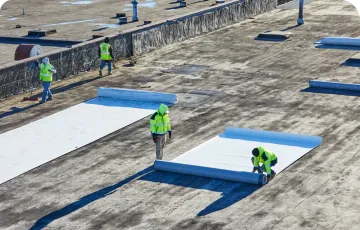
Owners of commercial property in Round Rock face a different test. The city requires a commercial re-roof permit when a flat roof is being replaced, and on a pitched roof only when the decking is being replaced. The page lists Building Inspections at 512-218-5550 for questions, and that is the number to call if your project sits close to either line.
We read the rule this way for our customers: no paperwork on a like-for-like shingle job, a permit question the moment the structure changes, and drip edge on every residential reroof regardless.
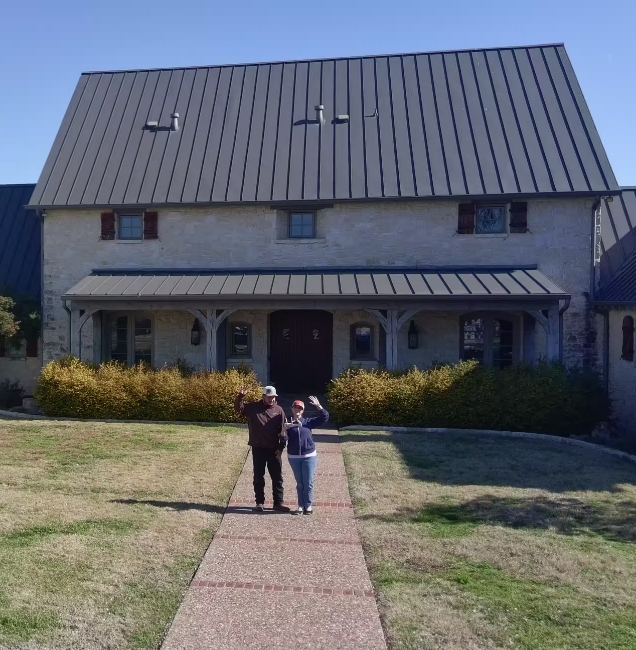
The Census Bureau puts the median Round Rock home at 2002, which means plenty of original roofs in the city are now past 20 years old. That age matters most when a storm turns a planned replacement into a claim.
The Texas Department of Insurance explains the difference with a worked example: a house insured for $200,000 with a 2 percent deductible, and a $10,000 roof destroyed by a covered storm. Replacement cost coverage pays $6,000 whatever the roof’s age. Actual cash value coverage subtracts depreciation first, and on a 20-year-old roof in that example it pays nothing at all (TDI, Replacement cost or actual cash value). TDI notes that actual cash value policies cost less but also pay less when you have a claim.
Look at your declarations page before the next storm, not after it. If your roof is covered at actual cash value, a replacement you plan and budget for yourself may cost you less in the end than waiting for hail to force it.
The first risk is quiet. A permit brings a city inspection with it, and a residential reroof in Round Rock usually has neither. That puts the quality check on two parties, you and the roofer, and it is why we photograph the deck, the flashing and the edge metal as the work goes on rather than only the finished roof.
The second is the one detail the city does name. Drip edge is a narrow strip of metal at the roof’s edge, and once the shingles are down it is hard to judge from the yard. A roof finished without it misses the code section Round Rock cites, even though no inspector came to check.
The third sits under the old shingles. Soft, stained or badly spaced decking only shows once the roof is stripped, and on a job nobody inspects, covering it up is the quick option. We photograph bad boards when we find them, show you, and replace them first.
Three choices decide how a new Round Rock roof looks, what an HOA has to sign off on, and how it meets the next big hail day. We talk them through at the assessment.
Asphalt shingles are the usual choice, and designer shingles give the same roof a thicker, layered profile. Tile belongs on Spanish and Mediterranean-style houses, and standing seam metal suits a modern elevation or just the porch roof. If a material change would mean altering the roof itself rather than its covering, that is the point where Round Rock’s remodel permit comes into play, so we settle it before you choose.
Impact resistance is not one grade. The Insurance Institute for Business and Home Safety tests impact-resistant asphalt shingles bought from ordinary retail stores, and its ratings page states that not all impact-resistant shingles perform the same when hail strikes. Ask us which products in your preferred color score well on those ratings, and ask your insurer whether a hail-rated roof earns a discount on your policy.
Where your subdivision’s deed restrictions cover roofing, an architectural committee may have a say on color and profile. The estimate carries the approved specification, we help you put the request together, and we can sit in on the board meeting.
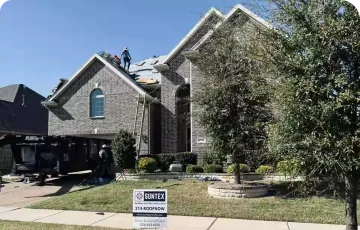
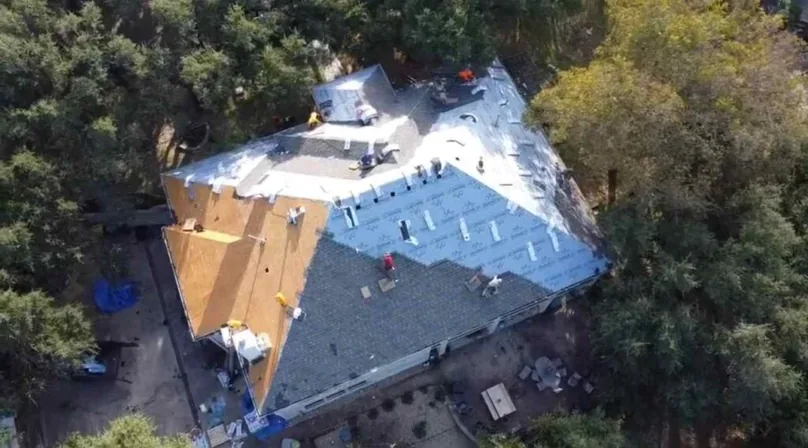
Everything comes off first: shingles or tile, the felt or underlayment beneath them, and the old metal at the chimney, the valleys and each vent pipe. Only with the deck bare can anyone see rot or a ventilation problem that was invisible from the yard. Any board that is water-stained, moldy, weak or laid with the wrong spacing for current standards gets swapped out at this stage.
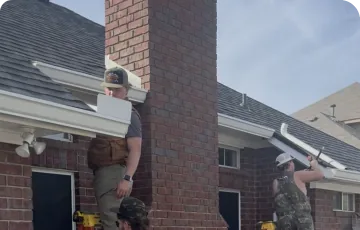
Next comes the metal at the perimeter. Drip edge is fastened along the eaves, where water leaves the roof, and up the rakes on the gable sides, which is the piece Round Rock’s rule calls for under the 2015 International Residential Code. The valleys and other weak spots get ice and water shield, and every pipe, chimney and vent gets new metal: pipe jacks, chimney flashing and ventilation collars.
A synthetic underlayment goes over the whole deck to shed any water that gets past the shingles. Starter shingles along the edges resist wind lifting the first course, then the field shingles are laid in offset rows up to the ridge. Ridge caps and ridge vents finish the top, the attic ventilation is checked while the ridge is open, with any improvement made only when it is needed and you sign off on it, and every piece is fastened the way its maker’s instructions require.
Your project manager keeps install day in this order, so you know what is happening on the roof and when.
Ahead of tear-off, the crew spreads tarps across beds and along the foundation to catch what falls from the eaves.
Waste comes off the roof in stages instead of piling up for the end of the day. With the new roof on, the gutters and roof surface are blown clear, a magnet sweep goes over the lawn for loose nails, and the old roofing and equipment leave with the crew.
The job closes with a walk around the house with your project manager, a check for anything missed, and a look through the photo record: the old roof, any boards we changed and the new roof.
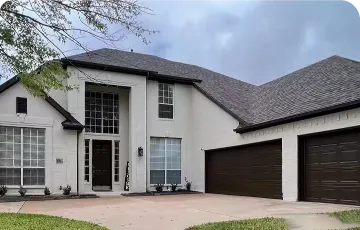
Whether age or a hail day brought you here, a Round Rock replacement starts in the same place: we photograph every slope for free and write a scope naming the material, the color and the drip edge.
Phone (214) 766-3669 between 7 am and 6 pm on any day, or use the form for a call back. Alex Keller runs our Central Texas and Austin sales, Round Rock included, and our only office is at 12800 Westridge Blvd, Suite 162, Frisco.
Reliability. Relationships. Results.
One free visit gets you photos and a written scope for a new roof.
Round Rock reroof questions
Not for a straight reroof. The City of Round Rock says it does not require a permit for residential re-roofing when no roof modifications are being made. If the work modifies the roof, you need a Residential Remodel Permit, and drip edge is required either way. Building Inspections answers questions at 512-218-5550.
Drip edge is the metal flashing installed along the eaves and rakes, the lower and sloped edges of a roof. Round Rock’s reroof rule says it is required under Section R905.2.8.5 of the 2015 International Residential Code. We list it on every replacement estimate so you can see it is included.
That depends on your coverage. With replacement cost coverage, TDI’s example pays the same amount whatever the roof’s age. With actual cash value coverage, depreciation comes off first, and in TDI’s example a 20-year-old roof is paid nothing after a 2 percent deductible. Your declarations page shows which you have.
Yes. The city requires a commercial re-roof permit when a flat roof is replaced. On a pitched commercial roof, a permit is needed only when the decking is being replaced. We roof residential, commercial and multi-family buildings, and we confirm which rule applies before the job is scheduled.
No residential roof comes with a promise against the biggest stones. IBHS tests impact-resistant shingles bought at retail and reports that they do not all perform the same, so the product matters as much as the label. Ask your insurer whether a hail-rated roof earns a policy discount before you choose.
Blog

© Copyrighted 2026 SunTex Roofing and Reconstruction. All Rights Reserved. Powered by Fast Hippo Media