



 (214) 766-3669

A McKinney roof has two jobs every spring: shed the hail, and keep its shingles flat when the gusts arrive. NOAA has logged hail an inch or larger at McKinney locations on 16 separate days since 2010, and when a roof starts failing at one job, the other usually is not far behind. Some calls end in a small repair, some in a new roof, and the assessment is how we tell them apart.

Send the form and we will call to set a time, or reach us at (214) 766-3669. Phones are answered every day of the week from 7 am to 6 pm.

 The McKinney crew list
Leanne Tolbert owns SunTex, and the company is woman-owned and operated from top to bottom. Danny Gutowski, our DFW sales manager, is typically the first person to walk a McKinney roof with you. A project manager such as Eric Sherman runs the job once you say yes, whether it is a repair or a full roof. Beth Keller keeps operations moving, and Suade Sherman runs the office in Frisco.
Our concierge service is a simple idea. You make the decisions that belong to you, such as repair or replace, the material, the color and the go-ahead, and we carry the rest of the work between the first call and the cleanup.

We install asphalt shingles, designer shingles, tile and standing metal. During the assessment we talk through how each one suits your house, your street and your budget, and if your neighborhood has an HOA, we match its approved specifications.

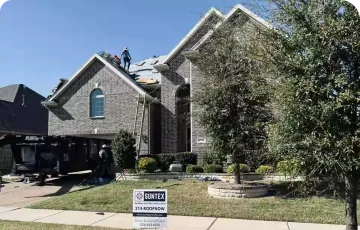
Every problem we find on your McKinney roof gets photographed. Those pictures help you understand the estimate, and they support an insurance restoration claim if a storm caused the damage.

One project manager schedules the crew, answers your questions and walks the finished work with you, so you never have to repeat your story to someone new. That holds for a one-day repair as much as for a new roof.
Call (214) 766-3669 or send the form. Mention the date of the storm if you know it, and anything you have spotted: granules in the gutters, a dented vent cap, shingles on the lawn, a new stain on a ceiling.
We come to your McKinney address, look over the roof surface and the metal parts that show hail best, and photograph the damage. You get a written estimate and a straight answer on repair versus replacement.
Once you approve the estimate, your project manager books the crew, keeps you updated and walks the completed work with you, whether that is a patched valley or a whole new roof.
Few cities we serve mix old and new the way McKinney does, and that mix shapes the roofing work here. The Census Bureau's 2020 to 2024 American Community Survey counts 77,617 housing units in McKinney. Of those, 1,128 were built before 1940 and 6,092 before 1980, while 3,783 have gone up since 2020 alone (U.S. Census Bureau, ACS table B25034). Another 11,568 date from the 1990s, which puts their original roofs well past the quarter-century mark if they were never replaced.
The same survey puts the median value of an owner-occupied McKinney home at $471,800, and 47,290 of the city's 74,072 occupied homes are lived in by their owners.
McKinney's storms do not stop at the city limit, and neither does our roofing work. To the south we look after hail-tested roofs in Allen, to the west we work on homes in fast-growing Prosper, and to the southeast we serve Wylie homeowners after hail. Our office sits southwest of McKinney on Westridge Blvd, which makes Frisco our home base for roofing on Frisco homes.
McKinney is one of the Collin County cities on a route that stretches across North Texas, Central Texas and the Austin area. Call (214) 766-3669 to set up a McKinney assessment.
100%
Woman-owned and operated
7 Days
Open 7 am to 6 pm
Free
Roof assessment and estimate
Since 2022
Serving Texas homeowners
Feedback
From residential and commercial roof replacement to urgent emergency roof repairs, our 5-star service speaks for itself.

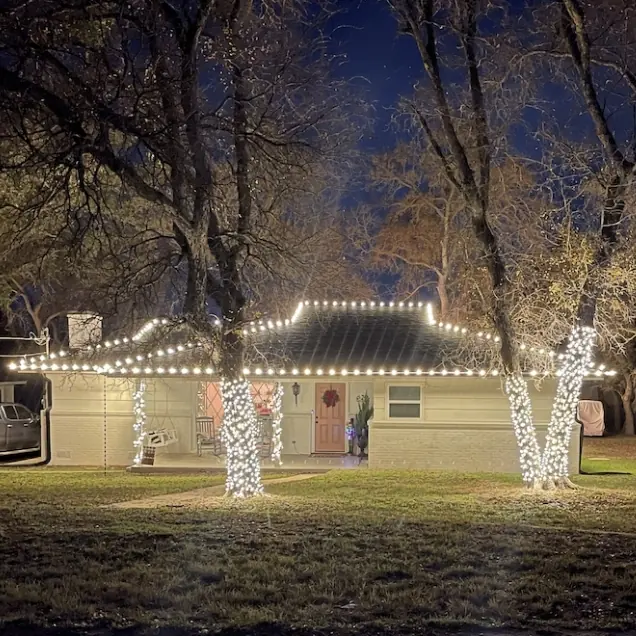
We used them for Christmas lights and could not have been happier. The entire process was so simple and our lights looked amazing. Very high quality and didn’t have one light bulb out the entire season. Highly recommend using them for your holiday lighting!

Bailey Pullin


Hands down recommend Beth and Alex with Christmas Lights and roofing consultations. Their communication is on point! Excellent service through your whole experience. We have been using them for two years now and will continue! Thanks yall!

Carin Gonzales
Highly recommend. Merry and Bright by Suntex Roofing made our home merry and bright this holiday season and are now my permanent go-to for my holiday lighting needs.

Chad Mandrell
The other day I had James Rose from SunTex do a courtesy inspection of our roof they replaced a little over a year ago. Mr. Rose was professional and knowledgeable when discussing how the drone inspection reveals no flaws or damage to the roof. I would definitely recommend SunTex to anyone look to have roof work done.

kalonji singleton
Alex Keller with SunTex Roofing exceeded! SunTex gave us a great experience from start to finish. The entire crew protected our new windows, plants, AC units, garden structures and even pool. I HIGHLY recommend this Texas local roofing company.

Sara Odom

Teri Redwine
SunTex provides unmatched customer support and response times. We moved into a new house with the previous owners creating a massive hole upon moving out. SunTex came out immediately and provided a temporary patch to mitigate damage from an incoming storm. Then came back for the official repair a few days later.

Alex Chase
Leanne and her team do GREAT work! Fast and clean as they do your roof replacement process. Leanne and her team are very professional. They get the job done. We are very pleased with our new roof, cutters and the restoration of our fence after the Salado Tornado this past April.

Gary Schmiedekamp
We used them for Christmas lights and could not have been happier. The entire process was so simple and our lights looked amazing. Very high quality and didn’t have one light bulb out the entire season. Highly recommend using them for your holiday lighting!

Bailey Pullin
100% cannot recommend enough!!! So thankful for SunTex. They helped us every step the way. They educated me and worked with me. I would highly recommend them to anyone needing roof replacement or repairs. Their staff is amazing! Cannot thank them enough.

Juan Cruz
Wind damage and hail damage can sit on the same roof without either one showing from the driveway. A free assessment with photos tells you what is there while the storm date is still easy to prove.

SunTex Roofing and Reconstruction started in 2022. We are 100% woman-owned and operated, our owner is Leanne Tolbert, and the names of our sales managers and project managers are published on our About page. Our only office is at 12800 Westridge Blvd, Suite 162, Frisco, TX 75035, the same address as our Google Business Profile.
Why that matters to a McKinney homeowner: storms can bring roofers from all over, and not every one of them is still around when the first question about the work comes up. A company with a fixed North Texas address and a named team is one you can call back, visit, and hold to its estimate.
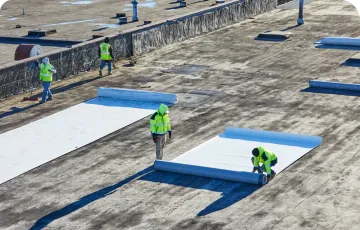
We roof houses, commercial buildings and multi-family properties. We handle repairs and full replacements, we install asphalt shingle, designer shingle, tile and standing metal roofs, and we replace gutters. Our assessments and estimates are free.
NOAA's Storm Events Database, the federal record of severe weather, holds 32 hail reports and 23 thunderstorm wind reports filed under McKinney between 2010 and mid-2026 (NOAA NCEI Storm Events Database). Twenty-eight of those hail reports were an inch or larger. Some of the entries name streets you probably drive:
These are reports from people and instruments that happened to be in the right place. They are not a map of every McKinney roof that took a hit, and plenty of storms go unreported street by street.
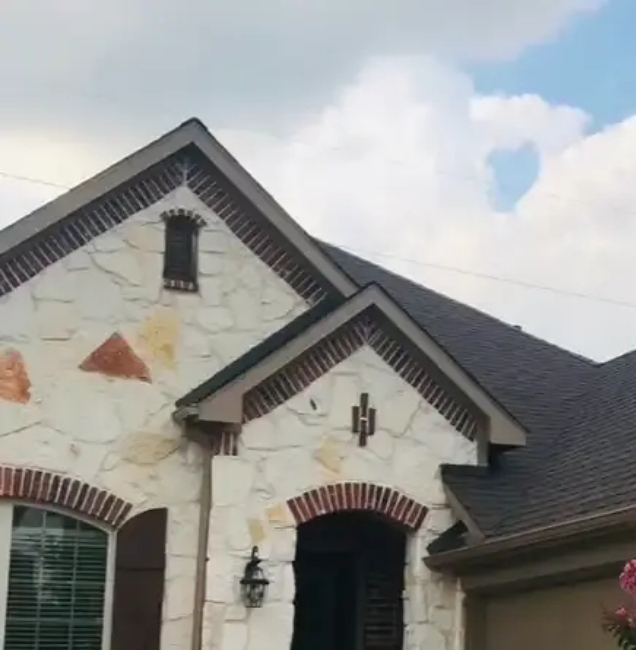
What people ask a roofer here depends on the age of the house. Owners of older McKinney homes usually want to know what is under the shingles: how many layers are up there, whether the decking is sound, and whether earlier repairs were done well. Owners in newer subdivisions tend to ask whether last spring's hail did enough damage to justify a claim, or whether a few repairs will carry the roof another season.
Almost everyone asks about looks. A roof is a large share of what you see from the street, and any new roofing should suit the house, whether that house went up before 1940 or after 2020.
The last request is evidence. Most owners want photos, dates and a written estimate they can hand to an adjuster, a buyer or a family member without having to explain it. We plan every job with that file in mind.
The National Weather Service treats a thunderstorm as severe when it produces hail at least one inch across, gusts of 58 mph or more, or a tornado (NOAA Storm Prediction Center FAQ). McKinney's own records clear both bars. The airport station measured a 66 mph gust on November 18, 2024 and 68 mph on May 26, 2025, and 28 of the city's hail reports reach the one-inch mark.
The two leave different marks. Hail bruises shingles, knocks granules loose and dents soft metal such as vent caps, flashing and gutters. Wind lifts shingle tabs and can break the seal that holds them flat, so the next gust has something to grab.
The trouble starts when they stack up. A roof that took hail in March meets the next round of wind with that damage already in place, and McKinney's calendar makes that sequence common. In March 2017, two-inch hail and 70 mph wind reports came three days apart. In March 2025, damaging wind on the 4th was followed by half-dollar hail at Lake Forest and US 380 on the 25th.
So we inspect for both on every McKinney assessment, even when the call is about one storm, and we tell you which damage a repair can handle.
When a roof does need replacing, we install four materials, and in McKinney the choice usually comes down to three questions.
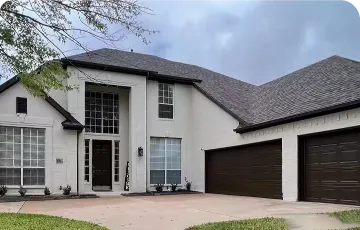
A house from the 1930s, a 1990s two-story and a 2022 build in a master-planned community each call for different roofs. Asphalt shingles suit most of them. Designer shingles add a heavier, dimensional look to larger homes. Tile fits Spanish and Mediterranean elevations, and standing metal works on modern designs and porch roofs. If your neighborhood has an HOA, its approved list narrows the field, and we match it.
Material choice is partly a storm decision. The Texas Department of Insurance tells homeowners to consider materials less likely to be damaged by wind, hail or fire, and notes that some insurers discount them. We offer impact-resistant options, and we can talk through how each material handles hail and wind before you commit.
Material affects cost, and tile and metal usually cost more than asphalt. Weight matters too, so if you are moving from shingles to tile, the structure has to be considered before the order is placed. We raise those questions during the assessment, not after the deposit.
A repair is the right call when the damage is limited: a few blown-off shingles, one cracked pipe boot, one length of flashing pulled loose. A full replacement makes sense when:
On a free assessment we tell you which of those applies. When a repair will do, we say so and quote the repair.
Hail often shows more clearly on metal than on shingles. Dented vent caps, dinged flashing and pocked gutters are some of the first things we look at, because they show how big the stones were and how they hit. Flashing that has been bent or pulled loose can let water in long before a shingle fails, so it gets the same attention as the roof surface.
On a repair, bent flashing can often be replaced on its own. On a replacement estimate, we note which metal pieces are damaged, so they are replaced with the roof instead of tying new shingles into bent metal.
McKinney still has 1,128 homes built before 1940. On a house that old, the shingles you see may not be the only layer, and the decking may carry decades of patches. Nobody can tell exactly what is there from the ground, and that includes us. Once the old roofing comes off, any soft or rotted decking is visible, and your project manager walks you through what needs replacing before the new roof goes on.
If you own a home from before 1980, plan for that possibility in your budget. It is far better to find bad decking during planned work than through a ceiling stain later.
The 3,783 McKinney homes built since 2020 are on their first roof unless a storm has already forced a replacement. Those roofs are young, but young does not mean hail-proof. When a newer roof needs attention, it is usually because of a storm, and the question is whether the damage is cosmetic or functional. We photograph what we find and give you an honest read, because a roof that only needs a few repairs should not be torn off.
Spring dominates. Of the 28 McKinney hail reports of an inch or more since 2010, 14 came in April and 6 in March. June added 5, and February and September have had them too. The year 2018 alone produced 9, six of them on April 13, from the courthouse to a few miles north of town.
Wind follows its own calendar. McKinney's wind reports run from February through November, including the 66 mph airport gust on November 18, 2024. If you notice lifted shingles in late fall, there is no reason to wait for spring before having them checked.
Insurance claims run on dates and evidence. The Texas Department of Insurance advises filing a claim as soon as you can, taking photos and video of all damage, and keeping receipts for temporary repairs (Texas Department of Insurance, getting your claim paid). Once your company has all the information it needs, it has 15 business days to accept or deny the claim.
We photograph the damage during the assessment, so the dated record exists from the start. Texas law also does not allow a roofer who is doing the work to act as your adjuster, so the claim decisions stay between you and your insurer, with our photos and estimate behind you.
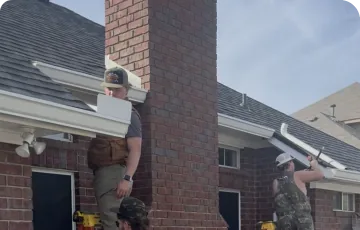
Hail that dents a vent cap dents gutters too, and gutters that sag or leak dump water against the fascia right below the roof edge. If your gutters are damaged or tired, replacing them during the roof work means one project, one schedule and one cleanup. We install aluminum, copper, steel and vinyl gutters, including continuous runs without joints, and we fit gutter guards and seamless gutter runs on McKinney homes.
Before a storm claim, find out what you will owe. The Texas Department of Insurance suggests asking your agent whether your policy has a different deductible for wind and hail damage than for other losses, because if it does, a storm can cost you more out of pocket than you expect. In a city where hail and wind reports pile up in the same spring, that one line in your policy decides a lot. Whatever the amount, Texas law says the deductible is yours to pay, and we will not offer to cover it.
Storm damage in McKinney is not limited to houses. The March 4, 2025 storm damaged a commercial building near Kentucky and McCauley Streets and caused major roof damage at a warehouse on South Airport Drive. The Census survey also counts 6,670 McKinney units in buildings of 50 or more. We roof residential, commercial and multi-family properties, and on a larger building we bring the same approach as on a house: photos of existing conditions, a written estimate, and one project manager working with the owner or manager.
Here is the order of events, from the first phone call to the last nail.
We ask what you have noticed, when the last storm came through your street, whether you have talked to your insurer, and roughly when the house was built. An older home and a newer one raise different questions, so the year helps.
We assess the roof and its metal parts, photograph everything we find, and give you a written estimate with a recommendation: repair, replace, or leave it alone. If a claim is involved, the photos support it. If you are choosing between materials, we bring that conversation to your kitchen table.
Your project manager confirms the crew date, keeps in touch during the work and walks the finished roof with you. Ask about the Roof Care Program before we wrap up if you want the roof inspected from then on.
The months before the work often look quiet. A few granules wash out of the downspouts after rain. One vent cap has a dent nobody noticed. A row of shingles near the ridge lifts during a March gust and never quite lies flat again. Then a summer storm finds the weak spot and a ceiling stain appears.
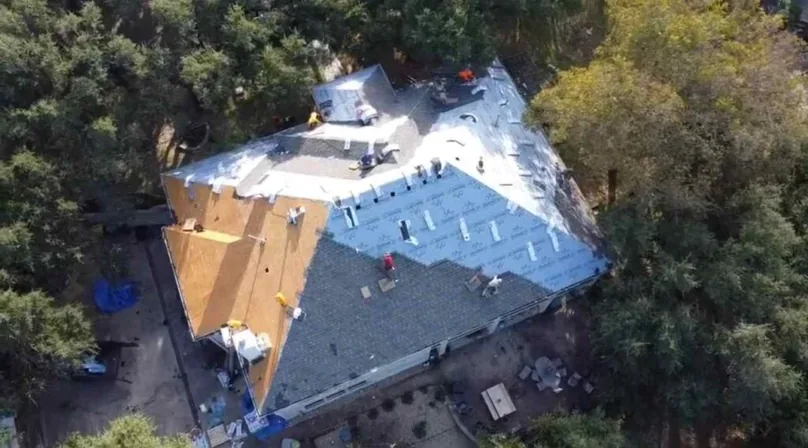
After a repair, the weak spots are closed: the lifted row is resealed or replaced, the bent flashing is swapped out, and you know from the photos what the rest of the roof looks like. After a replacement, the old layers are gone, any bad decking was replaced while it was exposed, and new flashing and vents tie into the new roof. If the gutters were tired, they were replaced in the same project.
The paper trail changes too. You have photos of the old roof, the storm damage and the finished work. That record is useful at resale, when a buyer's inspector asks about the roof, and after the next storm, when an adjuster asks what the roof looked like before.
And because McKinney storms will keep coming, the Roof Care Program offers members two inspections a year with a written roof health report and photos, so the record keeps growing.
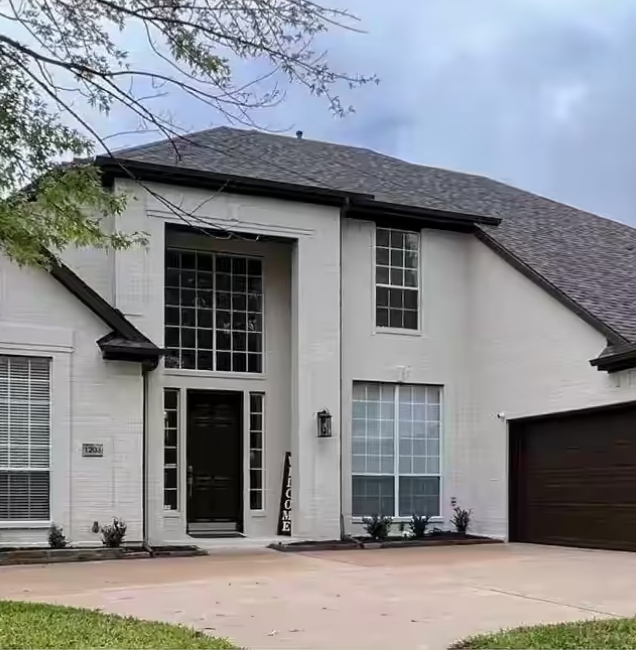
Maybe a storm just rolled through, maybe your home was built before 1980 and the roof is original, or maybe you are trying to decide between shingle and metal. The first step is the same in each case: a free assessment and a clear answer.
Call (214) 766-3669 between 7 am and 6 pm, any day of the week, or send the form and we will call you back. We will look at the roof and its metal, photograph what we find and write up an estimate you can read.
If you already suspect a repair will do, say so on the call, and we will check that first. If you have no idea yet, that is fine too; sorting repair from replacement is part of the visit.
Our office is at 12800 Westridge Blvd, Suite 162, Frisco, TX 75035, a short drive from McKinney.
Reliability. Relationships. Results.
One call to (214) 766-3669 gets your free roof assessment on the calendar.
What McKinney homeowners ask a roofer
We do, on every assessment. Hail bruises shingles and dents metal, and wind lifts shingle tabs and breaks their seals. NOAA's records show the two arriving close together here, such as two-inch hail and 70 mph winds three days apart in March 2017. A roof weakened by one is easier for the other to finish off, so we photograph each kind of damage separately, which keeps the dates and causes clear for you and for any claim.
Yes, when that is the honest fix. Dented vent caps and bent flashing are often the clearest sign of how large the hail was, and flashing pulled loose can leak before any shingle fails. If the rest of the roof is sound, we can replace those pieces on their own. If the roof needs replacing anyway, we note which metal pieces are damaged so they are replaced with it.
They give the adjuster dated evidence of what the storm did. The Texas Department of Insurance tells homeowners to take photos and video of all damage and to file as soon as they can. We photograph the damage during our assessment, so you have that record from the first visit. The decisions on your claim stay between you and your insurer.
Both, and they raise different questions. A house built before 1980 may have more than one layer of roofing, decking with years of patches, or repairs from earlier owners, and the full picture only shows once the old roof comes off. A newer home usually has its original builder roof, and the question there is mostly storm damage. We assess both kinds and tell you what to expect before work starts.
Yes. Hail that damages a roof tends to damage gutters on the same pass, and we install aluminum, copper, steel and vinyl gutters, including seamless runs and gutter guards. If your gutters are dented, sagging or leaking, doing them with the roof means one project and one cleanup. If they are in good shape, we leave them alone and tell you so.
Soon after any storm, while the date is fresh. Spring brings most of McKinney's hail, with 14 of the city's one-inch-plus reports in April, but wind reports run into November. Call us whenever you see damage, and we will help you plan any repair or replacement around your schedule and your claim.
Blog

© Copyrighted 2026 SunTex Roofing and Reconstruction. All Rights Reserved. Powered by Fast Hippo Media