



 (214) 766-3669

A roof that loses a few shingles in one storm can usually be put right. A roof that has been through several Temple windstorms is a different case: creased tabs on the windward side, unsealed shingles scattered over every slope, a new drip in a different room after each heavy rain. At that point a new roof is the repair that lasts, and the job is to plan it properly.

Send the form and we will call to set up a visit, or phone (214) 766-3669 any day between 7 am and 6 pm.
A new roof in Temple comes with more paperwork than a repair does. Three records travel with the job, and you should see each of them before the crew arrives.

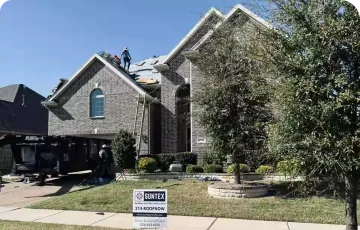
The City of Temple lists roofs among the residential upgrades that need a building permit. Once the permit is issued, the city asks for its placard to be posted somewhere conspicuous and visible from the street, so expect to see it on the house while the work is under way.

We photograph every slope before tear-off: the lifted and creased shingles, the metal at the edges and the ridge. That set is your record of why the roof was replaced, and it stays useful long after the job ends.

If a windstorm or hail is the reason for the replacement, the same dated photos support your insurance restoration claim. What the policy pays remains between you and your insurer; our part is the evidence and a clear scope of work.
Call (214) 766-3669 or use the form. Shingles on the lawn, a ceiling stain, a section that flaps when the wind picks up: tell us what you have seen and roughly when it started.
We assess the roof, photograph what we find and give you a written estimate. You choose the material and color from the options that suit the house.
Work starts once the City of Temple has issued the permit. Your Central Texas project manager then books the crew, keeps you updated and walks the finished roof with you.
Replacement is one of three kinds of roofing job we run in Temple. The city’s houses range from before 1940 to after 2010, with a median build year of 1991, and our Central Texas team’s roofing work across Temple covers that whole range.
Plenty of wind damage never needs a whole new roof. When the trouble is a few torn tabs or one slope of loose shingles, re-sealing and replacing wind-lifted shingles on Temple homes is the smaller job, and we price it next to a replacement so the comparison is honest.
Many Temple replacements start with a particular storm, and roof repair after wind and hail in Temple and greater Bell County begins by photographing that storm’s damage, dated, for the adjuster.
A Temple replacement is built to the same standard as the reroofs we install on houses from DFW down through Central Texas: same materials, same tear-off, same single project manager.
 Feedback
From residential and commercial roof replacement to urgent emergency roof repairs, our 5-star service speaks for itself.

We used them for Christmas lights and could not have been happier. The entire process was so simple and our lights looked amazing. Very high quality and didn’t have one light bulb out the entire season. Highly recommend using them for your holiday lighting!

Bailey Pullin


Hands down recommend Beth and Alex with Christmas Lights and roofing consultations. Their communication is on point! Excellent service through your whole experience. We have been using them for two years now and will continue! Thanks yall!

Carin Gonzales
Highly recommend. Merry and Bright by Suntex Roofing made our home merry and bright this holiday season and are now my permanent go-to for my holiday lighting needs.

Chad Mandrell
The other day I had James Rose from SunTex do a courtesy inspection of our roof they replaced a little over a year ago. Mr. Rose was professional and knowledgeable when discussing how the drone inspection reveals no flaws or damage to the roof. I would definitely recommend SunTex to anyone look to have roof work done.

kalonji singleton
Alex Keller with SunTex Roofing exceeded! SunTex gave us a great experience from start to finish. The entire crew protected our new windows, plants, AC units, garden structures and even pool. I HIGHLY recommend this Texas local roofing company.

Sara Odom

Teri Redwine
SunTex provides unmatched customer support and response times. We moved into a new house with the previous owners creating a massive hole upon moving out. SunTex came out immediately and provided a temporary patch to mitigate damage from an incoming storm. Then came back for the official repair a few days later.

Alex Chase
Leanne and her team do GREAT work! Fast and clean as they do your roof replacement process. Leanne and her team are very professional. They get the job done. We are very pleased with our new roof, cutters and the restoration of our fence after the Salado Tornado this past April.

Gary Schmiedekamp
We used them for Christmas lights and could not have been happier. The entire process was so simple and our lights looked amazing. Very high quality and didn’t have one light bulb out the entire season. Highly recommend using them for your holiday lighting!

Bailey Pullin
100% cannot recommend enough!!! So thankful for SunTex. They helped us every step the way. They educated me and worked with me. I would highly recommend them to anyone needing roof replacement or repairs. Their staff is amazing! Cannot thank them enough.

Juan Cruz
A free assessment answers that with photos instead of guesses. If a repair will hold, we will say so; if the roof has had its run, you get a written replacement scope.

The City of Temple’s permit guide lists roofs among the common residential upgrades that require a building permit, alongside siding, window replacement, fences and patio covers (City of Temple, Do I Need a Permit?). Applications go through the MGO Connect portal, and the city tells applicants to choose Temple rather than Bell County there. That distinction matters on the edge of town: some addresses with a Temple mailing address sit outside city limits, and the city points owners to its maps to check.
The same guide sets out the timeline. Intake usually takes one to two business days, plan review is set at 10 business days and can stretch when volume is high, and a permit request needs a site plan, for which an aerial map is accepted when no survey is on hand. A project number or a paid fee does not mean the permit has been issued, so the crew date follows the issued permit, not the application. We confirm with you how the permit is being handled before any tear-off is scheduled.
Age matters on a Temple claim, because so much of the city’s housing went up before 2000. The Texas Department of Insurance explains that replacement cost coverage pays up to the full cost of repairing a roof at current prices, while actual cash value coverage pays less when the roof is older or showing wear (Texas Department of Insurance, Insurance and your roof).
TDI adds three warnings worth reading before a storm, not after. As roofs age, some companies switch roof coverage to actual cash value at renewal. A roof in poor condition might not be covered at all. And no insurer will pay for a new roof just because the old one is old or worn out, so a claim has to rest on damage from a covered event such as wind, hail or a falling tree. Check the declarations page now, and ask your agent whether your wind and hail deductible differs from the deductible for other damage.
The first shortcut is laying new shingles over the old ones. The National Roofing Contractors Association notes that building codes in many instances allow no more than one re-cover before a complete replacement is required (NRCA consumer FAQ). On a Temple house from the 1970s or 1980s, nobody can tell from the yard whether that one re-cover has already been used, and a second layer also hides decking that wind-driven rain may have softened.
The second is replacing only the slope that faced the storm. It looks economical, but it leaves two roofs of different ages and colors on one house, and the older half keeps every unsealed shingle that is still waiting for its next storm.
The third is skipping the city. Temple’s permit guide puts roofs on its list of work that needs a permit, and a job started without one can stall when the city finds out. Planning the permit into the schedule from the first visit keeps the work on track.
The material sets the look of the house for years and changes how it handles the next windstorm. Three decisions come up at almost every Temple assessment.
Architectural asphalt shingles balance cost against durability, which is why they are the usual choice. Designer shingles add a heavier, dimensional profile for owners who want the roof to read as a feature of the house. Whichever you pick, ask us for the manufacturer’s wind classification on that product line before you sign.
Standing seam metal suits modern elevations and can cover the whole roof or just a porch, while tile fits Spanish and Mediterranean styles. Both change the profile of the house more than a shingle swap does, so we walk through the look and the framing questions at the assessment.
Reflective shingles are made to cut solar heat gain through the roof, which can lower cooling costs. If the house has an HOA, we check the color against the approved list before ordering.
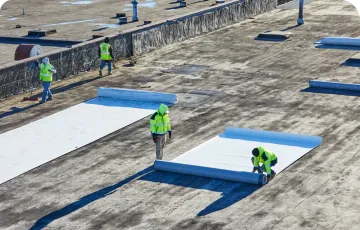
For flat or low-slope roofs over shops, offices and apartment buildings, we also install TPO, EPDM, modified bitumen and metal on Temple commercial buildings, with the same photo record and project manager.
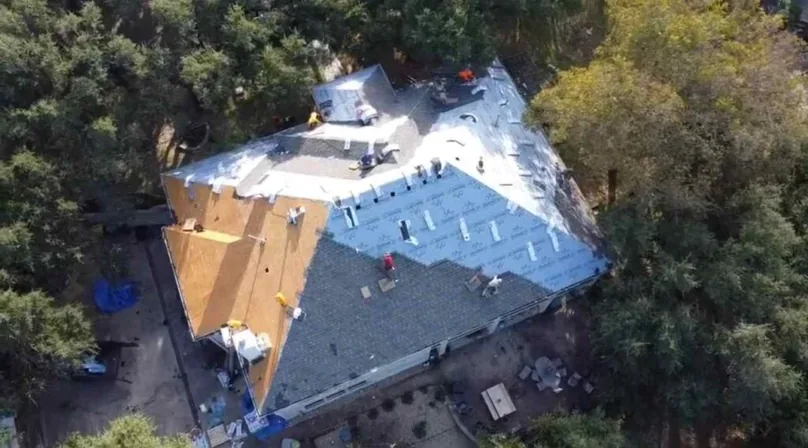
The crew removes every layer of the old roof: shingles or tile, the old felt or underlayment, and the flashing at chimneys, valleys and vent pipes. With the deck bare, any boards that are water-damaged, moldy, structurally unsound or spaced wrongly for current standards are replaced before anything new goes on. We photograph each board we replace, so you can see what the old roof was hiding.
The National Weather Service notes that isolated wind damage is possible once winds are sustained at 40 to 50 mph, and that straight-line winds in strong thunderstorms can exceed 100 mph (National Weather Service, Wind). That is why the edges get the most attention. Drip edge runs along the eaves and rakes, starter shingles reinforce the perimeter against uplift, and the main courses go down in staggered rows so each seal lands over the joint beneath it.
Ice and water shield goes into the valleys and other vulnerable spots. New pipe jacks, chimney flashing and vent collars go around every penetration, ridge caps close the top, and if our look at the attic shows the ventilation falling short, we recommend a fix and make it with your approval. Every product goes on to its manufacturer’s specifications.
Temple schedules inspections through the MGO Connect portal or its inspection voicemail, which the city checks at 4 pm each day. A request received before 4 pm goes on the next day’s schedule; one received after 4 pm is scheduled two days out. Residential remodel work does not get a certificate of occupancy, so the issued permit and its inspections are the city’s record of the new roof.
Install day is loud. It does not have to be messy, and your project manager runs it in this order.
Before the first shingle comes off, tarps go over flower beds and the ground along the walls, so tear-off debris lands where it can be gathered.
Old material is cleared as the crew works across the roof rather than left in piles for the end, and the deck is never left bare longer than it takes to dry it in.
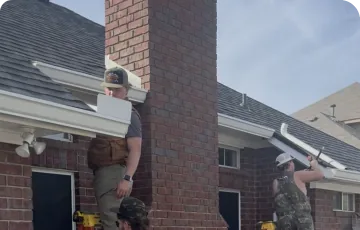
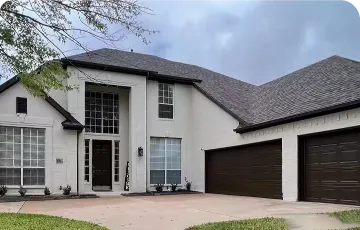
With the new roof on, the crew blows off the roof and gutters, sweeps the lawn with magnets for stray nails and hauls away the waste. Your project manager then walks the property with you and hands over the photos of the old roof, the replaced decking and the finished work.
Start with the facts: photos of every slope, an honest read on repair versus replacement, and a written scope that names the material, the color and how the city permit fits the schedule.
Call (214) 766-3669 from 7 am to 6 pm, seven days a week, or send the form and we will call you back. Our Central Texas team covers Temple, and our only office is at 12800 Westridge Blvd, Suite 162, in Frisco.
Reliability. Relationships. Results.
Book your free assessment and get a written replacement scope for your Temple house.
Temple roof replacement questions
Yes. The city’s permit guide lists roofs among the common residential upgrades that require a building permit. Applications are made through MGO Connect, choosing Temple rather than Bell County, so check first that your address is inside city limits. Work should start only after the permit is issued, and we confirm how it is being handled before we schedule your crew.
The city says intake usually takes one to two business days, after which a fee is invoiced, and plan review is set at 10 business days once the fee is paid. That review time can stretch when the city is busy. Paying the fee or getting a project number does not mean the permit is issued, so we plan your crew date around the issued permit.
We do not recommend it. NRCA notes that building codes in many instances allow no more than one re-cover before a full replacement is required, and on an older Temple house that re-cover may already be there. A full tear-off also exposes damaged decking that a second layer would hide, so every Temple replacement we do goes down to the deck.
It can, if a covered event such as wind or hail damaged the roof, and depending on your policy. TDI is clear that an insurer will not pay for a new roof just because the old one is old or worn out, and that some companies switch aging roofs to actual cash value coverage at renewal. Read your declarations page, and we will document the storm damage with photos for your claim.
Yes. We install asphalt, designer shingle, tile and standing seam metal, and a replacement is the natural time to change. Metal and tile alter the look of the house more than a shingle does, so check any HOA rules first, and ask us at the assessment how the framing and the city permit handle the change.
Blog

© Copyrighted 2026 SunTex Roofing and Reconstruction. All Rights Reserved. Powered by Fast Hippo Media