



 (214) 766-3669

Nobody hands you a manual for the roof when you buy a new house. Then a ceiling spot appears after a storm, or a shingle turns up on the lawn, and you are hiring a roofer for the first time with no idea what a fair answer sounds like. We start with the cause, show it to you, and keep the repair to what the roof actually needs.

Send the form, or call (214) 766-3669 any day from 7 am to 6 pm, and describe what you have seen inside and out.
A first repair should leave you knowing more about your roof than you did before. Three things come out of every visit.

You see photos of the problem itself: the cracked boot, the gap in the flashing, the creased shingle. Knowing why the water got in makes the next decision easy to judge.

A failed boot or a few loose shingles is a small job. We fix the part that failed and leave the sound roof around it alone, and if the damage is wider than one spot, the photos show that too.

The National Roofing Contractors Association lists the indoor signs of roof trouble as cracked paint, discolored plasterboard and peeling wallpaper. We point out where on your house those would show first.
Put a bucket under any drip and move what you can out of the way. Photograph the stain and anything wet before you clean up.
If you have the closing papers, the roofing product name or spare bundles in the garage, set them aside. They help us match the repair.
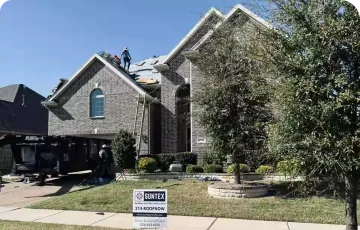
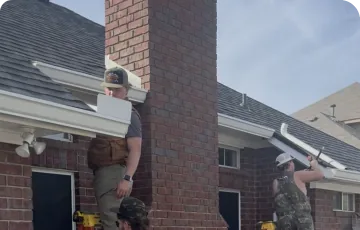
We come to your Liberty Hill address, check the attic side where we can and the roof itself, and photograph the cause before we write the estimate.
On a house built in the last decade, a repair may be the first time anyone has been on the roof since the builder left, and it sits alongside the rest of the roofing services we bring to Liberty Hill homes in town and on the county roads.
When hail has marked most of the roof rather than one spot, a repair stops being the honest answer, and a full replacement of a hail-damaged young Liberty Hill roof walks through depreciation and impact-resistant options.
If a specific storm caused the problem, storm damage roof repair for Liberty Hill’s newer houses ties the photos to that storm’s date and works within the Texas rules on claims and deductibles.
Every Liberty Hill repair follows the same approach as roof leak and shingle repairs we handle from DFW to Williamson County: cause first, matched material, photos at each stage.
 Feedback
From residential and commercial roof replacement to urgent emergency roof repairs, our 5-star service speaks for itself.

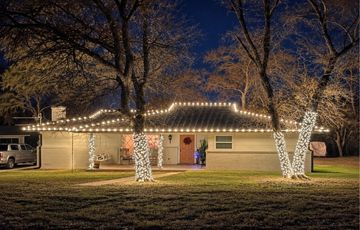
We used them for Christmas lights and could not have been happier. The entire process was so simple and our lights looked amazing. Very high quality and didn’t have one light bulb out the entire season. Highly recommend using them for your holiday lighting!

Bailey Pullin


Hands down recommend Beth and Alex with Christmas Lights and roofing consultations. Their communication is on point! Excellent service through your whole experience. We have been using them for two years now and will continue! Thanks yall!

Carin Gonzales
Highly recommend. Merry and Bright by Suntex Roofing made our home merry and bright this holiday season and are now my permanent go-to for my holiday lighting needs.

Chad Mandrell
The other day I had James Rose from SunTex do a courtesy inspection of our roof they replaced a little over a year ago. Mr. Rose was professional and knowledgeable when discussing how the drone inspection reveals no flaws or damage to the roof. I would definitely recommend SunTex to anyone look to have roof work done.

kalonji singleton
Alex Keller with SunTex Roofing exceeded! SunTex gave us a great experience from start to finish. The entire crew protected our new windows, plants, AC units, garden structures and even pool. I HIGHLY recommend this Texas local roofing company.

Sara Odom

Teri Redwine
SunTex provides unmatched customer support and response times. We moved into a new house with the previous owners creating a massive hole upon moving out. SunTex came out immediately and provided a temporary patch to mitigate damage from an incoming storm. Then came back for the official repair a few days later.

Alex Chase
Leanne and her team do GREAT work! Fast and clean as they do your roof replacement process. Leanne and her team are very professional. They get the job done. We are very pleased with our new roof, cutters and the restoration of our fence after the Salado Tornado this past April.

Gary Schmiedekamp
We used them for Christmas lights and could not have been happier. The entire process was so simple and our lights looked amazing. Very high quality and didn’t have one light bulb out the entire season. Highly recommend using them for your holiday lighting!

Bailey Pullin
100% cannot recommend enough!!! So thankful for SunTex. They helped us every step the way. They educated me and worked with me. I would highly recommend them to anyone needing roof replacement or repairs. Their staff is amazing! Cannot thank them enough.

Juan Cruz
A small stain caught early can mean a small repair. A free assessment finds the cause and shows it to you.

A leak on a young roof does not mean the whole roof has failed. NRCA’s answer to “my roof is leaking, do I need it replaced?” is “not necessarily”: leaks can come from flashing that has come loose or from one damaged section, while a complete roof failure is generally the result of improper installation or the wrong choice of materials (NRCA consumer FAQ).
On a newer Liberty Hill roof, the places we check first are the ones that seal around something. Pipe boots are rubber or neoprene collars around plumbing vents, and Texas sun cracks them. Flashing at walls, valleys and vents can shift or crack. And installation details matter on any roof, new ones included: nails driven too far or not far enough, misaligned shingles or a missing starter strip can all let water in years before the shingles wear out. When we find one of those, we photograph it and fix it, without guessing at who is to blame.
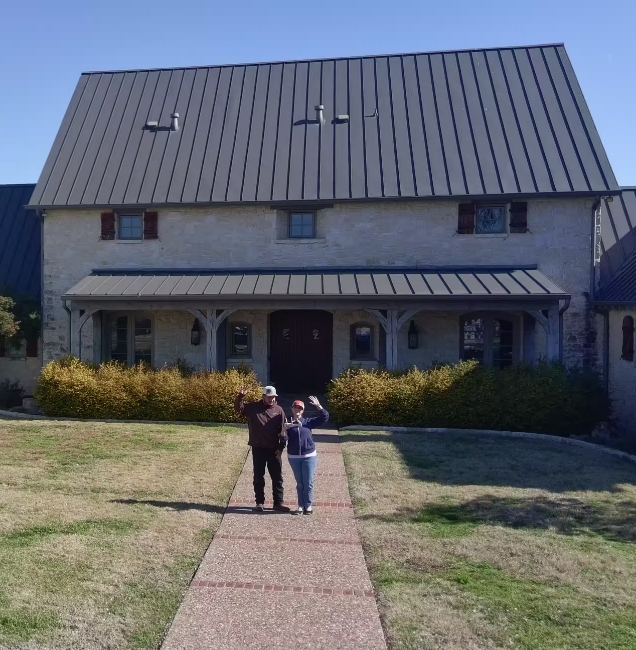
Insurance treats a leak by its cause. The Texas Department of Insurance says most home policies do not cover water damage from gradual leaks or seepage, while sudden and accidental water damage is usually covered, and many policies pay for damage from falling objects such as trees (TDI, Homeowners insurance and disaster claims FAQ).
The same TDI page says it is generally fine to make temporary repairs after damage, but not permanent ones until you have talked to your insurer, and that the policy should pay for the materials and labor of those repairs. Take pictures of the damage before any work. If a storm caused your leak, that order of events, photos first, temporary fix second, permanent repair after the insurer is in the loop, protects the claim.
Weather finds young roofs early here. NOAA has filed 22 hail reports under Liberty Hill since 2010, 15 of them since the start of 2023, and town reports include gusts estimated at 60 to 70 mph. Hail can crack a shingle or dent a vent cap; a gust can lift a tab and break its seal without moving it far.
Sun does its own work. The rubber and neoprene in pipe boots crack in Texas heat faster than the shingles around them age, so a roof that looks almost new from the street can still have one boot letting water into the attic.
Then there is the house settling into its first years: a satellite dish or a solar mount added after closing, a gutter clogged by a neighbor’s oak, a valley full of leaves. Each one can send water somewhere the roof was never meant to carry it. None of these mean the roof was badly built.
Most repairs come down to three choices. Here is how we lay them out for someone who has never had to make them.
When one shingle or one boot failed, fixing that spot is the right answer. When a storm marked a whole slope, TAMKO’s guidance on replacing shingles after hail is to inspect the whole slope rather than swap only the visibly damaged pieces, and we price a wider repair if the photos call for it.
The Asphalt Roofing Manufacturers Association notes that installers generally leave owners some extra shingles, and that these give the best match for a repair. If you have them, we use them. If not, the color name and install year help us find the closest product on the market.
A small repair may cost less than your deductible, in which case a claim pays nothing. Compare our written estimate with the deductible on your declarations page before you decide whether to call your insurer.
A cracked boot leaks right at the vent pipe, often showing as a dark spot in the attic or a stain on a bathroom ceiling. Replacing the boot is a short job when it is caught early.
Metal flashing at walls, chimneys, valleys and vents keeps water out of the joints. If it has moved or cracked, we reseat or replace it so it laps correctly under the shingles above.
A shingle that lifted but did not tear can be sealed back down, and ARMA lists resealing wind-damaged shingles among the quick repairs. A creased or torn shingle is replaced with the closest match we can find.
When a nail works up out of the deck, it lifts the shingle above it and opens a path for water. The fix is to unseal the shingle upslope, pull the old fastener, set a new one beside it and seal the shingle back down.
You are welcome to follow along. A first repair visit runs in this order.
We look at the stain and, where the attic is reachable, at the underside of the roof deck above it. Water marks there narrow down where to look on top.
On the roof, we follow the likely path upslope from the stain to the point where water gets in, and photograph what we find.
We make the repair, photograph it next to the before pictures, and walk you through what failed and what to watch for. Members of the SunTex Roof Care Program, with two roof inspections a year get flashing, pipe jack and vent checks on every scheduled visit after that.
Start with a free assessment, photos of the cause and a written answer on what the repair involves. You will know what failed before you decide anything.
Call (214) 766-3669 from 7 am to 6 pm any day of the week, or send the form and we will call you back. Our Central Texas team covers Liberty Hill, and our only office is in Frisco at 12800 Westridge Blvd, Suite 162.
Reliability. Relationships. Results.
Call (214) 766-3669 and we will book your free roof assessment.
Liberty Hill roof repair questions
Not necessarily. NRCA says leaks can come from loose flashing or one damaged section, and that a full roof failure generally comes from improper installation or the wrong materials. On a roof only a few years old, the cause can be a single part: a cracked pipe boot, shifted flashing or a few storm-damaged shingles. We find it, show it to you and price the repair.
TDI explains that most home policies do not cover water damage from gradual leaks or seepage, while sudden and accidental damage is usually covered. A storm that tears off shingles is a sudden event; a boot that cracked and dripped for months is likely to be treated as gradual. Your policy wording and your adjuster decide, so photograph the damage and call your insurer if a storm was involved.
Yes. ARMA notes that installers generally leave extra shingles and that they are one of the best ways to match a repair. Keep them dry and flat, and note the product and color name if it is on the wrapper. Even with a perfect match, a fresh repair looks a little different until it has weathered alongside the rest of the roof.
From the ground and the ladder, yes; from the roof, leave it to us. NRCA suggests confining homeowner checks to spring and fall, using a firmly braced ladder with rubber feet and staying on the ladder rather than the roof. Look for cracked or curling shingles and granules in the gutters, and inside for stains, cracked paint or peeling wallpaper.
Each scheduled visit for members covers the whole roof, plus the flashing, pipe jacks, roof vents, shingle condition and sealant, with minor sealant touch-ups, valley and debris removal, an attic moisture check when the attic is accessible, and a written roof health report with photos. Membership includes two visits a year, priority scheduling after severe weather and preferred repair pricing.
Blog

© Copyrighted 2026 SunTex Roofing and Reconstruction. All Rights Reserved. Powered by Fast Hippo Media