(214) 766-3669

A replacement is the one moment you get to decide how the roof meets the next hailstorm. Whatever went on your house in the 1990s or the 2010s, the next roof can be chosen on purpose, with a rating you can look up and paperwork your insurer will accept.

Send the form and we will call to set up the visit, or phone (214) 766-3669 any day between 7 am and 6 pm.
The estimate is where a replacement either gets clear or gets vague. Ours is written to answer the questions owners usually ask too late.

The scope names the material, the product line and the color, so the roof you approve is the one that arrives. If you want an impact-rated product, we list its rating class next to its name.

Before anything comes off, we photograph each slope, the flashing, the vents and any soft spots we can see. Those photos are the before record for the project and for any claim tied to it.

If a storm is behind the replacement, we explain how replacement cost and actual cash value coverage treat a roof of your roof’s age. What your insurer settles is between you and them.
Hail, age, a leak that keeps coming back or a sale coming up: each one changes what the estimate needs to cover, so say which when you call or fill in the form.
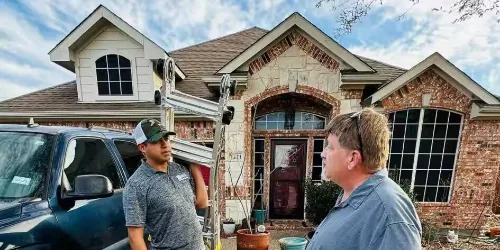
Our Central Texas team assesses the roof, photographs it and sits down with you over the materials. If hail resistance matters to you, we look up ratings for the specific products together.
Once you approve the written scope, your project manager orders the material, sets the date and stays your contact through cleanup.
Replacement is one part of our Central Texas team’s roofing work around Belton, where the housing splits between older homes and a wave built since 2010. Not every worn roof needs to come off, and when the trouble is a single leak, a lifted run of shingles or a cracked boot, a smaller fix for Belton roofs built from the 1990s on costs less and keeps the sound parts in place. When a storm is the reason for the call, the dates and streets in Belton’s hail and wind record, with how to document a claim help tie the damage to the right afternoon. Every Belton reroof follows the same standard as our residential reroofing in asphalt, designer shingle, tile and metal, with the same project managers and the same written scope.
 Feedback
From residential and commercial roof replacement to urgent emergency roof repairs, our 5-star service speaks for itself.

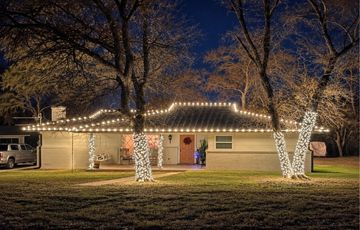
We used them for Christmas lights and could not have been happier. The entire process was so simple and our lights looked amazing. Very high quality and didn’t have one light bulb out the entire season. Highly recommend using them for your holiday lighting!

Bailey Pullin


Hands down recommend Beth and Alex with Christmas Lights and roofing consultations. Their communication is on point! Excellent service through your whole experience. We have been using them for two years now and will continue! Thanks yall!

Carin Gonzales
Highly recommend. Merry and Bright by Suntex Roofing made our home merry and bright this holiday season and are now my permanent go-to for my holiday lighting needs.

Chad Mandrell
The other day I had James Rose from SunTex do a courtesy inspection of our roof they replaced a little over a year ago. Mr. Rose was professional and knowledgeable when discussing how the drone inspection reveals no flaws or damage to the roof. I would definitely recommend SunTex to anyone look to have roof work done.

kalonji singleton
Alex Keller with SunTex Roofing exceeded! SunTex gave us a great experience from start to finish. The entire crew protected our new windows, plants, AC units, garden structures and even pool. I HIGHLY recommend this Texas local roofing company.

Sara Odom

Teri Redwine
SunTex provides unmatched customer support and response times. We moved into a new house with the previous owners creating a massive hole upon moving out. SunTex came out immediately and provided a temporary patch to mitigate damage from an incoming storm. Then came back for the official repair a few days later.

Alex Chase
Leanne and her team do GREAT work! Fast and clean as they do your roof replacement process. Leanne and her team are very professional. They get the job done. We are very pleased with our new roof, cutters and the restoration of our fence after the Salado Tornado this past April.

Gary Schmiedekamp
We used them for Christmas lights and could not have been happier. The entire process was so simple and our lights looked amazing. Very high quality and didn’t have one light bulb out the entire season. Highly recommend using them for your holiday lighting!

Bailey Pullin
100% cannot recommend enough!!! So thankful for SunTex. They helped us every step the way. They educated me and worked with me. I would highly recommend them to anyone needing roof replacement or repairs. Their staff is amazing! Cannot thank them enough.

Juan Cruz
Get a free assessment and a written scope before anyone orders material. You will see the photos and the product options side by side.

Be wary of anyone who says a roof is rated for hail like Belton’s 2014 storm. The strictest hail option in the IBHS FORTIFIED program, its optional Hail Supplement, asks for asphalt shingles rated Good or Excellent in IBHS testing, metal panels at UL 2218 Class 4 and tile at FM 4473 Class 4. IBHS says those shingles outperform typical Class 4 products against realistic hailstones and better protect a home from hail up to 2 inches in diameter. The 4.25-inch stone that fell here was more than twice that.
That does not make the upgrade pointless. Of the 27 hail reports NOAA has filed under Belton’s name since 2010, 23 were 2 inches or smaller, the range those ratings are built around. A better-rated roof is a bet on the storms Belton gets most often, not a promise about the rare one, and we say so plainly when we price it.

Texas sorts impact-resistant roofing into four classes. The Texas Department of Insurance explains that a roofing material qualifies for a discount only after a test lab checks it for impact resistance under a recognized standard, and products that pass are rated Class 1, 2, 3 or 4, with Class 4 earning the highest premium credit (TDI, products qualifying for impact-resistant roofing credits).
The state does not set the discount. Each insurance company decides what each class earns, which test results it accepts, how the product must be labeled and what paperwork the contractor and the homeowner send in. TDI publishes an installation form, PC068, that some insurers use while others ask for their own. So the order matters on a Belton reroof: call your agent first, ask what class and what form they want, and then we choose the product.
The first trap is buying the label instead of the product. The Insurance Institute for Business and Home Safety tests real products with realistic hail impacts, grades the granule loss, dents, cracks and tears it finds, and its conclusion is that impact-resistant shingles do not all perform the same. An owner who picks on color alone can end up with the weaker of two products that share a class.
The second is ordering before the insurer weighs in. An impact-rated roof installed without the label, test record or form your insurer asks for may never earn the credit you were counting on, and the paperwork is far easier to gather before the old roof is hauled away than after.
The third sits under the shingles. Decking that took water through an old hail hole only shows once the roof is stripped. We stop, photograph it, show you, and replace the bad boards before any new layer goes on, so the new roof is not fastened to rot.
The material sets how the house looks for years and how the roof meets hail. These are the three choices we walk through at the kitchen table.
Architectural shingles are the common choice on Belton houses. Designer shingles give a heavier, layered look. Both come in impact-rated versions, and that is where the IBHS comparison earns its keep.
Standing metal and tile change the profile of the house and the way hail marks the roof: metal panels dent where shingles bruise or crack. Ask your agent how your policy treats hail dents on metal before you choose it.
If your Belton subdivision has a homeowners association, we match its approved material and color in the scope and will attend the meeting if the board wants to talk it through.
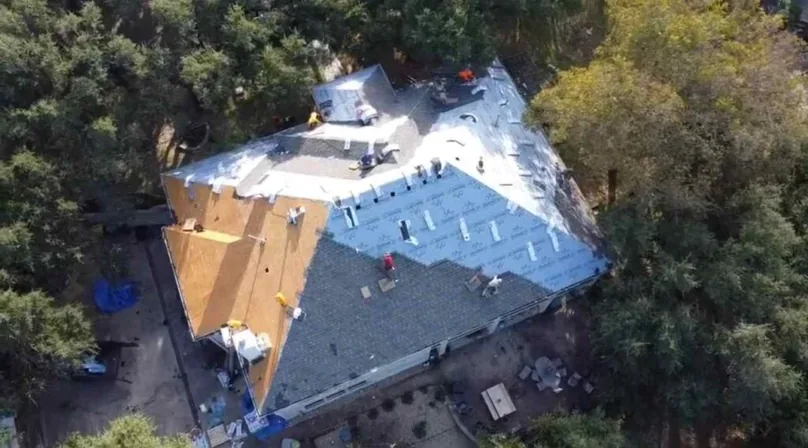
The crew removes the old shingles, underlayment and flashing down to the decking. Only then can anyone see boards softened by water or nail lines that no longer hold, and those get replaced and photographed before work moves on.
Drip edge goes on at the eaves and rakes before the field of the roof. The Asphalt Roofing Manufacturers Association explains why in its bulletin on installing drip edge at eaves and rakes: it sheds water that would otherwise run back under the shingle edge and rot the deck and fascia. ARMA calls for a corrosion-resistant edge that reaches at least 2 inches onto the sheathing and a quarter inch below it, set under the underlayment at the eaves and over it at the rakes, and it strongly recommends drip edge on every shingled roof.
Underlayment covers the whole deck as the second line against water. Valleys, walls, chimneys and each vent pipe get new flashing and new collars, because those joints are where most leaks begin and reusing tired metal under a new roof saves very little.
The shingles or panels go on to the manufacturer’s instructions, then the ridge and vents close the top. If you chose an impact-rated product, we keep the wrapper labels and product details your insurer asked for, so the credit request has what it needs.
When a covered storm leads to the new roof, the money usually arrives in more than one piece, and knowing the order keeps the budget from surprising you.
With replacement cost coverage, the Texas Department of Insurance’s claim guide says you may get two payments. The first covers the estimated repair cost minus depreciation, which TDI defines as the drop in value from your home’s condition and age. Your deductible comes out too.
If you have a loan on the house, the insurer usually sends the payment to your mortgage company, which TDI says must contact you within 10 days of receiving it. You then work with the lender to release the money for the work.
TDI’s guide says the second payment comes after the repairs are done. That is one more reason the scope, the photos of the old roof and the record of the finished one matter: they are what you hand over to close the claim.
Whether hail forced the question or the roof has simply reached its age, the first step is a free assessment, photos of every slope and a written scope that names the product and its rating.
Call (214) 766-3669 any day from 7 am to 6 pm, or send the form and we will call you back. Scheduling and paperwork run through our office at 12800 Westridge Blvd, Suite 162, Frisco, TX 75035, and our Central Texas team does the work in Belton.
Reliability. Relationships. Results.
Book a free assessment and get a written replacement scope.
Belton replacement questions
Not that we know of, and we would not sell one on that promise. The toughest hail option in the FORTIFIED program is built around hail up to 2 inches, and the March 2014 stone measured 4.25. What a better-rated roof does is hold up better in the storms Belton gets far more often: 23 of the 27 hail reports filed under the city’s name were 2 inches or smaller.
Whatever your insurer asks for, which TDI says each company decides for itself. Keep the product name, the rating class, the wrapper labels and any installation form, whether that is TDI’s PC068 or the insurer’s own. TDI’s list of what a qualifying label carries is a useful checklist: the testing lab’s label, the impact class, the manufacturer, the year made and the brand name.
Only if your policy pays replacement cost. TDI’s claim guide explains that the first payment is the estimated cost minus depreciation and your deductible, and the second comes after the repairs are done. On a roof covered at actual cash value, the depreciation is not paid back at all. Your declarations page shows which coverage you have.
Not always. If the damage stays on one slope and the rest of the roof is sound, a repair or a partial replacement may be the honest answer. If hail bruised several slopes, the roof is older, or your insurer has approved a full replacement, replacing it all usually makes more sense. Our photos show you which situation you are in.
For most Belton owners, the case rests on the ordinary storms. Golf ball hail, 1.75 inches on the Storm Prediction Center’s chart, appears six times in the reports filed under the city’s name, and it sits inside the range where FORTIFIED says its top-rated shingles outperform typical Class 4 products. Add any premium credit your insurer offers, set against the price difference we quote, and you have the numbers to decide.
Blog
© Copyrighted 2026 SunTex Roofing and Reconstruction. All Rights Reserved. Powered by Fast Hippo Media