







 (214) 766-3669
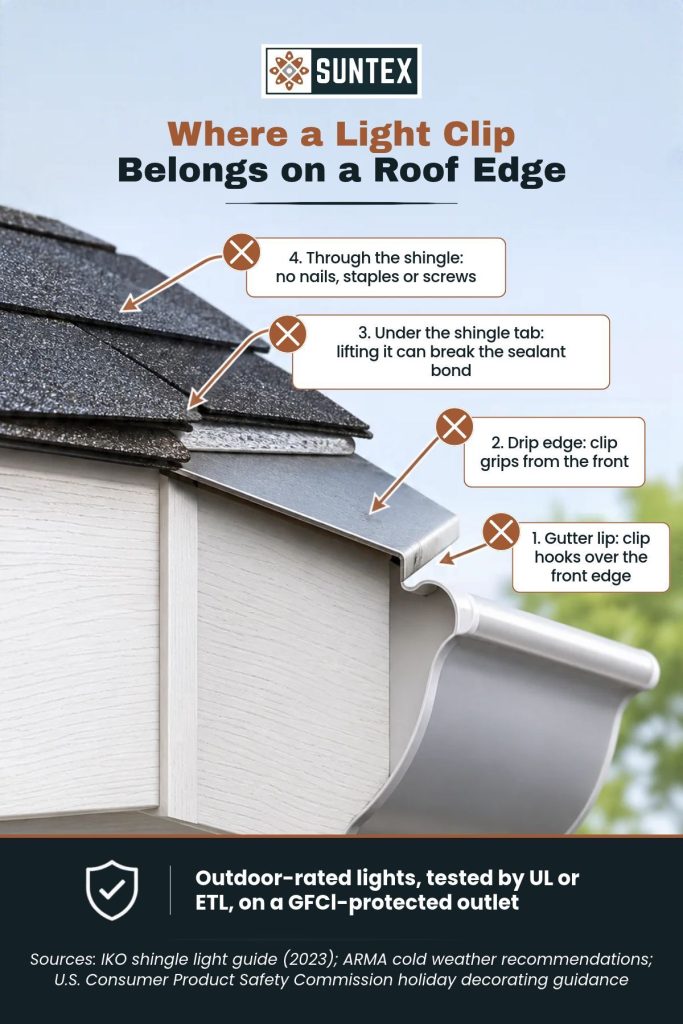
The rule for hanging Christmas lights on roof shingles is short: nothing goes through them. No nails, no staples, no screws. A light string belongs on clips that hook over the gutter lip or grip the drip edge, put up on a dry, mild afternoon when the shingles bend instead of crack. Every hole made in November is a hole the spring rain gets to test.
We roof houses across Frisco, Plano, Allen, and McKinney, and we hang holiday lights too. That puts us at the exact spot where the two jobs meet, which is the first course of shingles.
TL;DR
Nothing that pierces the roof belongs in a holiday light setup. The Asphalt Roofing Manufacturers Association (ARMA) says roofing nails should never sit where they show on a finished roof, and IKO, a shingle manufacturer, says even small holes in shingles can create leaks. Use clips that hook over the gutter lip or grip the drip edge from the front. Skip clips that tuck under shingle tabs, because lifting a tab can break the sealant bond that holds it down in wind. Hang on a dry, mild day: ARMA notes shingles get less flexible as the temperature drops and frost on a slope can be close to invisible. Plug into a GFCI-protected outlet with lights certified for outdoor use, keep the ladder away from the service line coming in from the pole, and unclip strings one at a time in January instead of pulling them down.
Why Is One Nail Through a Shingle Worth Avoiding?
A shingle roof only sheds water when every fastener sits under the course above it. ARMA’s guidance on nailing asphalt shingles tells installers never to place nails where they will be fully or partially visible once the roof is complete. A nail driven through the face of a shingle to hold a light string is exactly that: an exposed fastener sitting in the path of the water.
The nail itself is the easy part to see. The harder part comes in January. Either the nail stays and rusts in place, or it comes out with the lights and leaves an open puncture behind. IKO’s guide to hanging lights on a shingle roof puts it plainly for its own product: no nails, staples, or screws, because even small holes in shingles can create leaks.
Water rarely drips straight down from a small hole on a sloped roof. It tends to run along the underlayment or the deck first, so a ceiling stain can show up a few feet from the puncture that caused it. Holes from old decorations belong on the same list as cracked pipe boots and exposed nail heads.
| Fastener | Where it usually goes | What it leaves behind |
|---|---|---|
| Nail through the shingle face | Along the first course at the eave | An exposed fastener, then an open hole after removal |
| Staples through shingles | Quick runs along the roof edge | The same problem, once per staple |
| Screw-in hooks in the fascia | Gable trim and eaves | A hole in painted wood trim rather than the roof |
| Clip over the gutter lip | Gutters along the eave | Nothing, if it comes off by hand |
| Clip gripping the drip edge | Eaves and rakes with no gutter | Nothing, if it grips and is not screwed |
Reading Your Own Roof Edge Before You Buy Clips
Buy the clip for the edge it has to hold. Stand in the yard, look at the lowest edge of each slope, and note what is actually there. Most houses show a mix of the edges below, and each one takes a different clip.
Gutters along the eaves
Where a gutter runs, the front lip of the gutter is the easiest anchor on the whole house. Plastic gutter clips hook over that lip and hold the bulb or the wire, and nothing touches a shingle.
What sits in the trough matters. A gutter packed with fall leaves holds water against the clips and adds weight to the run, so clean it before the lights go up, starting at the downspout end and working back toward the middle of the run.
Gutter guards change the picture a little. Some guard designs tuck under the first course of shingles, and a clip that pries at that joint lifts the shingle by another route. Clip to the outer lip of the gutter and leave the guard’s back edge alone.
Rakes and eaves without a gutter
On a gable end, or an eave with no gutter, the metal drip edge is the next choice. IKO’s advice for these edges is to clip to the drip edge or the shingle edge without lifting the shingle in a way that breaks its bond to the one below. A clip that grips the edge from the front passes that test. One that has to slide up underneath does not.
Peaks and ridgelines
Peak clips straddle the ridge and grip the shingles on both sides. They hold well. The problem is that someone has to be on the roof to set every one of them, and a two-story ridge is a long way up.
Tile and standing seam metal
We install tile and standing seam metal as well as asphalt and designer shingles, and neither material takes kindly to improvised fasteners. Clay and concrete tile can crack under a careless step, so tile clips are built to grip the edge of the tile without anyone walking the field. On standing seam metal, a screw through a panel is a hole in a roof that depends on unbroken panels, so seam clips grip the raised seam instead. Check any clip against the panel or tile maker’s instructions before buying a box.
| Edge on your house | What holds the light line | What to leave alone |
|---|---|---|
| Gutter | Clip over the front lip | The joint where a guard meets the shingle |
| Drip edge | Edge clip gripping from the front | Screws through the metal |
| Shingle edge with no gutter | Flat edge clip that does not lift the tab | Tabs that slide under the course |
| Ridge | Peak clip, set from the roof | Walking a wet or frosted slope |
| Tile | Tile clip on the tile edge | Stepping on the tile field |
| Standing seam metal | Clip made for the seam profile | Screws through the panels |
Are Under-Shingle Tabs Safe on a Texas Shingle Roof?
They are the clip we would leave in the box. A tab that slides under a shingle has to lift that shingle to get in, and most asphalt shingles are held down by a strip of thermally activated sealant that bonds each course to the one below once the sun has warmed it. Pry the edge up, and the bond can break. IKO recommends avoiding clips that tuck under shingles for that reason.
A broken seal does not show from the street. The shingle lies flat on a calm day and lifts in the first strong gust, because wind gets under a loose tab far more easily than a sealed one. Spring storms in Collin County bring hail and high winds to Plano, Allen, and McKinney, and an unsealed row along the eave is the row most exposed to them.
Age makes the problem worse. The Census Bureau’s 2020 to 2024 American Community Survey puts the median Plano home’s build year at 1993, and many roofs on Plano’s 1980s and 1990s houses are either original or on their second set of shingles. A shingle that has spent decades in Texas sun bends less and cracks sooner when a tab is pried under it.
Hail does the same thing faster. A shingle bruised in a spring storm can look fine from the yard, and lifting it for a light tab is a poor way to find the damage. On a roof that took hail this year, have the eaves looked at before anyone pries at an edge.
The Cold Morning Problem With Shingles
ARMA’s cold weather recommendations for asphalt shingles were written for roofers, and two of them carry straight over to light hanging. Shingles become less flexible as the temperature drops, so lifting or bending them in the cold can crack them. And frost or ice on a sloped roof can be nearly invisible, which the same bulletin calls extremely hazardous.
The same document warns that in cold weather the sealant bond between courses becomes less flexible, and roof traffic can break it.
Our own installations typically start in October and run into early December. In North Texas, that window holds warm afternoons and frosty mornings within the same few weeks, so the calendar date matters less than the conditions on the day.
Wait for all of these before anyone climbs:
- The roof is dry, with no dew, frost, or rain left on it.
- The sun has been on the shingles for a few hours.
- The wind is light enough that a string does not whip around.
- The ladder is the right one for the height and stands on level, firm ground, which is the U.S. Consumer Product Safety Commission’s own ladder advice for holiday decorating.
- A second person is on the ground holding the ladder and handing up the string.
Power for a Roofline String Starts at the Outlet
The roof edge is only half of the job. The other half is getting power to it safely, and most of the rules here come from the U.S. Consumer Product Safety Commission (CPSC).
CPSC’s outdoor holiday lighting guidance is old enough to predate LED strings, and most of it still holds. It also lines up with the roof: fasten outdoor lights to firm supports, using insulated staples or hooks, and never nails or tacks.
| Check | What CPSC says |
|---|---|
| Testing mark | Use lights tested by a recognized laboratory such as UL or ETL |
| Outdoor rating | Check the label for outdoor certification before the lights go outside |
| Outlet | Plug outdoor lights into circuits protected by ground fault circuit interrupters (GFCIs) |
| Extension cords | Use a cord rated for the intended use |
| Damaged sets | Throw out sets with cracked sockets, frayed wire or loose connections |
| Strings in a row | CPSC’s current holiday page says never string together more than three sets of incandescent lights |
| Overnight | Turn the lights off at bedtime or when you leave the house |
One line in that guidance deserves its own paragraph: stay away from the power or feeder lines that run from utility poles into older homes. It is aimed at older houses for a reason. McKinney has more than 1,100 homes built in 1939 or earlier, according to the Census Bureau’s 2020 to 2024 American Community Survey, and on McKinney houses that old, the line from the pole can land right at the eave or the gable you planned to light. Keep the light run and the ladder well clear of it.
What 4,000 Feet of Roof-Edge LED at Frisco Square Tells a Homeowner
Frisco’s biggest roofline display is a useful reference point. Christmas in the Square, presented by the Frisco Square Property Owners Association in partnership with the City of Frisco, opens on November 20, 2026, and runs to January 4, 2027.
- Over 180,000 lights
- 4,000 feet of roof-edge LED RGB lighting
- 10 miles of wiring and 8 miles of extension cords
- Lights and music nightly from 6 to 10 PM, free to the public
Nobody hangs 4,000 feet of roof-edge lighting by eyeballing it from a ladder. A display that size starts with measured runs, power planned for each circuit, and a takedown date set before the first light goes up. A single-family roofline is a far smaller job, but the order is the same: measure, plan the power, then hang.
Opening night is also when a lot of Frisco households start thinking about their own roofline, and it falls the week before Thanksgiving. If you plan to have a crew hang yours, book early, because the dates closest to the holidays go first.
Taking the Lights Down in January Without Tearing the Edge
Most damage at the roof edge happens on the way down, not the way up. CPSC’s guidance is never to pull or tug on outdoor lights, because the strain on the connections can create a fire hazard. A tug also drags every clip along the gutter lip and can lever up any shingle a clip was touching.
- Unplug the string at the outlet before anyone climbs.
- Start at the far end and work back toward the plug, freeing each clip by hand.
- Coil the string as it comes off so it is not hanging from the clips still in place.
- Collect every clip. A clip left in a gutter becomes a debris catcher by spring.
- Walk the eave from the ground and look for any lifted tab, a bent gutter lip or a clip still hanging on.
A lifted shingle after takedown is a small roof repair, not a holiday problem. ARMA describes hand-sealing shingles with an approved asphalt roofing cement where the bond is in doubt, and a loose eave course is the kind of thing our free roof assessment is there to catch before the spring storms arrive.
When we install your lights, we come back for the takedown too, and most displays come down in January.
Ladder, Clip Box or a Crew: Choosing Who Hangs It
Plenty of homeowners hang their own lights well, and the table below is meant honestly. The line falls where the job stops being about clips and starts being about height, slope, and roof material.
| Your house | A reasonable DIY job | Better handed to a crew |
|---|---|---|
| Single story, gutters all the way around | Gutter clips from a ladder on a dry day | Only if the design climbs the roof |
| Two-story with a gutter at each eave | Lower eaves from a ladder | Upper eaves, gables, and anything above the first floor |
| Ridgelines in the design | Nothing on the ridge | Every peak clip, since each one is set from the roof |
| Tile or standing seam metal roof | Lights on shrubs, trees, and the entry | Anything on the roof itself |
| Roof that took hail this year | Nothing that touches a shingle | The whole roofline, after the roof has been looked at |
If most of your answers land in the right-hand column, our Christmas light installation runs through Merry & Bright, our holiday lighting partner. It starts with a free design consultation where we take measurements and quote the job, then the installation itself, service calls through the season if a bulb goes out or weather affects the display, and a scheduled takedown. We install our own commercial-grade LED lighting rather than strings you already own.
Whoever you hire, us included, ask one question before you sign: what touches the shingle, and how does it come off in January? A crew that roofs for a living should answer that without hesitating.
Before the First Clip Goes Up on Your Frisco Roofline
Start with the roof, then the lights. Walk the eaves from the yard, note every edge you plan to light, and look for anything already wrong: a lifted tab, a dented gutter lip, granules piling up at a downspout. Fix those first, because a light string draws the eye to the roof edge for six weeks.
If something up there looks off, our office on Westridge Blvd is the base for roof repairs and new roofs across Frisco, and every job starts with a free roof assessment. If the roof is sound and you would rather not climb at all, we can plan the lights as well.
Either way, SunTex Roofing and Reconstruction would rather see a roofline lit with clips than patched in April.